Swift WMS and BatchMaster side by side
| Topic | Swift WMS | BatchMaster |
|---|---|---|
| Lot traceability | Lot and expiration on every plate. Lot Trace forward, batch records both ways, and Recall Impact with one-step lot holds. (Core and Pro) | Lot traceability and recall, named on its home page as a core strength alongside compliance and mobile warehousing. Source |
| License plates | Every quantity sits on a license plate in a named location, with its own history. (All plans) | Its mobile warehousing app builds licensed or non-licensed pallets for putaway and validates location, license ID, lot number, and quantity. Source |
| BOM production | Bills of materials, work orders, staging, batches, and a line schedule with capacity planning. (Core and Pro) | Formulation and packaging, batch production, master production scheduling (MPS), and material requirements planning (MRP) modules. Source |
| Customer portal | Customers see their own inventory, orders, batch records, COAs, and invoices. (Included on Pro; an add-on on Essentials and Core) | A Customer Portal module. Its nutraceutical page offers private-label clients 24/7 portal access to monitor orders, shipments, labels, and documents. Source |
| Pricing transparency | Starting prices are published: Essentials from $599, Core from $2,499, and Pro from $4,999 a month, with users included. Extra users and add-ons are quoted. | No prices on its site. Buyers request a personalized live demo. Source |
| Ideal customer | Small to mid-size manufacturers, co-packers, and food and CPG plants. | Growing, mid-market recipe- and formula-based manufacturers, in its own words. Source |
Lot traceability
- Swift WMS
- Lot and expiration on every plate. Lot Trace forward, batch records both ways, and Recall Impact with one-step lot holds. (Core and Pro)
- BatchMaster
- Lot traceability and recall, named on its home page as a core strength alongside compliance and mobile warehousing.
Source
License plates
- Swift WMS
- Every quantity sits on a license plate in a named location, with its own history. (All plans)
- BatchMaster
- Its mobile warehousing app builds licensed or non-licensed pallets for putaway and validates location, license ID, lot number, and quantity.
Source
BOM production
- Swift WMS
- Bills of materials, work orders, staging, batches, and a line schedule with capacity planning. (Core and Pro)
- BatchMaster
- Formulation and packaging, batch production, master production scheduling (MPS), and material requirements planning (MRP) modules.
Source
Customer portal
- Swift WMS
- Customers see their own inventory, orders, batch records, COAs, and invoices. (Included on Pro; an add-on on Essentials and Core)
- BatchMaster
- A Customer Portal module. Its nutraceutical page offers private-label clients 24/7 portal access to monitor orders, shipments, labels, and documents.
Source
Pricing transparency
- Swift WMS
- Starting prices are published: Essentials from $599, Core from $2,499, and Pro from $4,999 a month, with users included. Extra users and add-ons are quoted.
- BatchMaster
- No prices on its site. Buyers request a personalized live demo.
Source
Ideal customer
- Swift WMS
- Small to mid-size manufacturers, co-packers, and food and CPG plants.
- BatchMaster
- Growing, mid-market recipe- and formula-based manufacturers, in its own words.
Source
Where Swift WMS fits
BatchMaster calls itself process manufacturing ERP software for growing, mid-market recipe- and formula-based manufacturers. It covers formulation, batch production, quality, compliance, costing, and accounting, and it names lot traceability and recall as a core strength. Its mobile warehousing app builds licensed pallets for putaway and validates the location, license ID, and lot number.
Swift WMS is a smaller product with a narrower job. It is built for the plant that makes and stores product for other brands. Every quantity sits on a license plate in a named location, on every plan, and each plate keeps its owner and its own history. Ingredient SKUs need a lot name and an expiration date before a receipt can be saved. See license plate inventory for the plate actions.
Swift WMS covers part of BatchMaster's ground too, in less depth. On the Core plan it has percent-based formulas with substitute ingredients, testing profiles for each brand's products, a cost per unit chart built from materials, labor, and overhead, and invoicing for your brands. It has no general ledger, no standard costing, and no record of test results. The list near the end of this page says where that gap matters.
On the Core plan, Lot Trace follows one lot forward to every plate and shipment it reached. Recall Impact starts from a bad lot and lists the downstream lots, the work in progress, and where product shipped, and you can hold every impacted lot in one step. The lot traceability page covers both screens.
What each customer portal shows
BatchMaster and Swift WMS both sell a customer portal, so the useful question is what each one shows. BatchMaster's Michou Deli story describes a portal for wholesale buyers: they place orders online, track shipments, and download paid and unpaid invoices, and each customer sees only its own data. Its nutraceutical page also offers private-label clients portal access to monitor orders, shipments, labels, and documents.
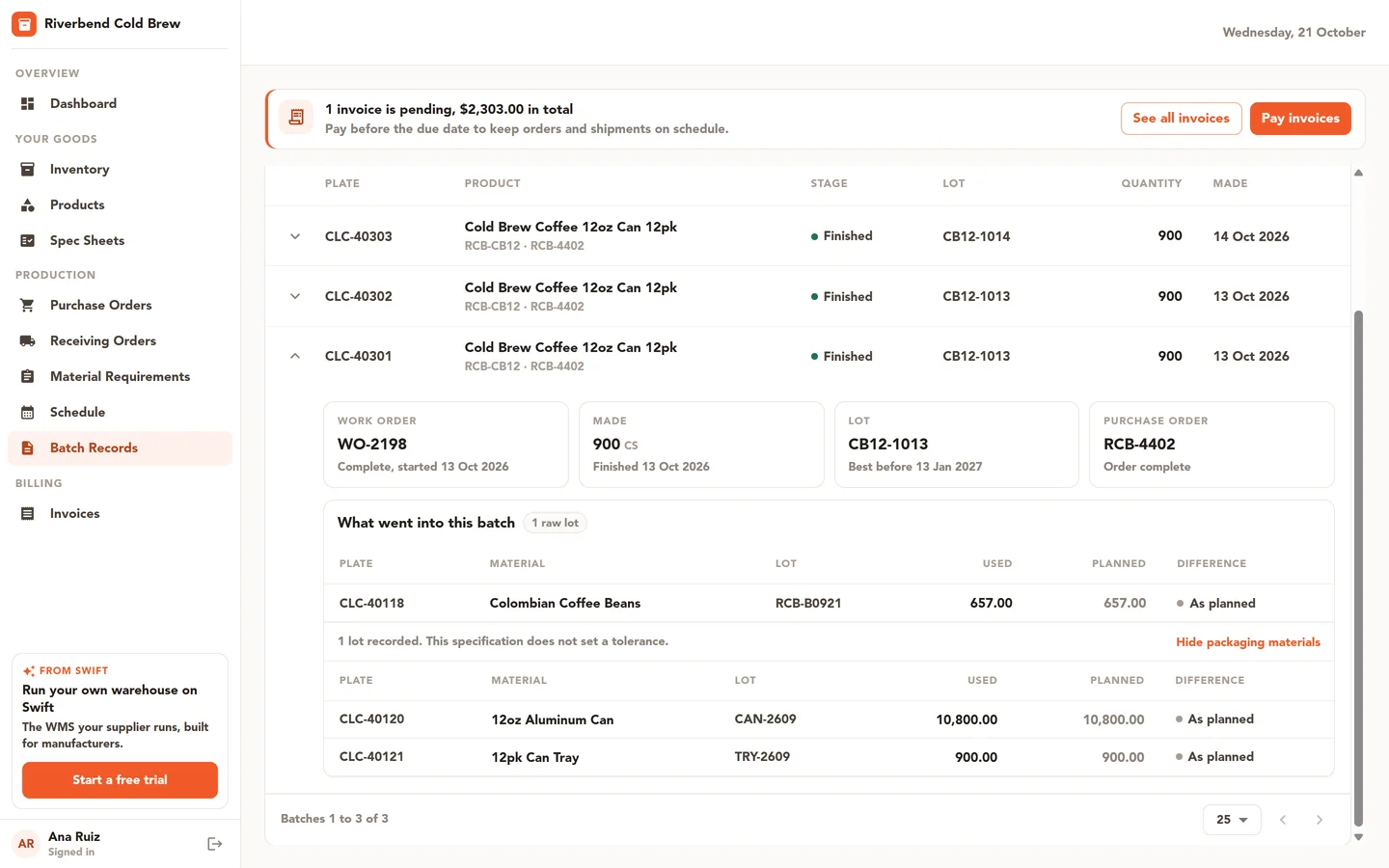
The Swift WMS portal is built around what you hold and make for each brand. A portal user can see its own inventory by SKU and lot, open batch records that list every lot used in a run, download the COAs your team attached, and review and e-sign spec sheets. Brands can also place purchase orders through a wizard, which your team approves or rejects. The portal is included on Pro and is an add-on on Essentials and Core. The customer portal page covers access settings.
Contract work and customer-owned stock
BatchMaster's nutraceutical page says it handles customer-supplied materials, client-specific specs, segregated inventory, and subcontracted production flows. If you run BatchMaster today, ask your team or theirs to show you that work on your own floor.
In Swift WMS, customer-owned stock is the starting point, not a separate flow. Every license plate is received under the brand that owns it, and it keeps that owner through holds, batches, and shipments. On Core, each brand's purchase order creates work orders. Your team stages the exact plates a run needs and builds batches by consuming them, so each finished lot records the brand's lots that went into it.
Billing your brands from the same records
Co-packers charge for more than the product. Pallets sit in your racks for weeks, and each receipt takes labor at the dock. WMS invoicing on the Core plan bills storage, receipts, and other fees from the same records your floor keeps. You can add manual lines and rates, email invoices, and record payments, and a brand with portal access can see its invoices and pay online. The BatchMaster pages listed under Sources do not describe billing clients for storage or receiving.
Our co-packers and contract manufacturers page walks through the full routine, from receiving a brand's materials to billing for the space they use.
When BatchMaster is the better fit
BatchMaster goes deeper into the formula, the lab, and the books than Swift WMS does. These are the cases we would point to ourselves.
- Your formula is the product. BatchMaster's nutraceutical page offers potency-based formulation that accounts for label claims, and inventory tracked by potency. On Core, Swift WMS formulas can set ingredient lines as a percent of the batch, list substitute ingredients, and split a blend into batches by a maximum batch weight, with target and actual quantities. But Swift WMS keeps one unit of measure per SKU and does not track potency.
- You need supplement facts panels. BatchMaster's nutraceutical page says it can auto-create supplement facts panels, ingredient declarations, and allergen-safe labels. Swift WMS does not make labels like these. It stores allergens on each SKU, prints them on license plate labels, and lists them for each ingredient on spec sheets.
- You want accounting in the same system. BatchMaster offers an edition with its own accounting module, and editions that add manufacturing to the accounting software you already run. Swift WMS is not accounting software and has no general ledger. On Core, it invoices your brands, adds late fees, shows aging, records payments, and exports payments to a CSV file for your books.
- You need product costing. BatchMaster builds formula costs from materials, labor, and losses, and compares actual to expected costs. On Core, Swift WMS charts the actual cost per unit of finished goods by day, week, or month, from the materials used, the labor in production entries, and your overhead percent. It does not keep a standard cost or show a variance.
- You need QC tests and stability studies. BatchMaster lets you define QC tests with accepted values inside formula specs, and its nutraceutical page lists stability tests and non-conformances. On Core, Swift WMS testing profiles list each test, its method, its stage, and its limit for a brand's products, and cleaning checklists are signed off item by item. Swift WMS holds and releases lots and stores COAs, but it does not record test results, stability studies, or non-conformances.
- You want an on-premise install, or an online store integration. BatchMaster's Enterprise Edition runs on-premises or in the cloud, and its nutraceutical page describes a connection to online storefronts. Swift WMS runs in our cloud, in the browser, and does not offer online store integrations.
Common questions
- Does BatchMaster have lot traceability?
- Yes. BatchMaster names lot traceability and recall on its home page, and its mobile warehousing app keeps records of warehouse moves for lot traceability reports. In Swift WMS, every license plate carries its lot, and ingredient SKUs need a lot name and expiration date at receipt. Lot Trace, batch records, and Recall Impact with one-step lot holds are part of the Core plan.
- Does BatchMaster have a customer portal?
- Yes. BatchMaster sells a Customer Portal module. Its Michou Deli story describes wholesale buyers placing orders online, tracking shipments, and downloading invoices, and its nutraceutical page offers private-label clients access to orders, shipments, labels, and documents. The Swift WMS portal shows each brand its own inventory by lot, batch records with every lot used, attached COAs, and invoices.
- Does BatchMaster support contract manufacturing?
- Its nutraceutical page says it does, with customer-supplied materials, client-specific specs, segregated inventory, and subcontracted production flows. In Swift WMS, every license plate is received under the brand that owns it, each brand sees only its own records in the portal, and WMS invoicing on Core bills storage and receipts from the same records.
- Does Swift WMS make supplement facts labels?
- No. Swift WMS does not make supplement facts panels or nutrition labels, and it does not track potency. It stores allergens on each SKU, prints them on license plate labels, and lists them for each ingredient on spec sheets. On Pro, brands can review and e-sign those spec sheets in the portal. It also keeps lot, hold, COA, and batch records. If label math is the center of your work, BatchMaster may suit you better.
- Does Swift WMS publish its prices?
- Yes, its starting prices. Swift WMS publishes starting prices: Essentials from $599, Core from $2,499, and Pro from $4,999 a month, with users included. Extra users, the customer portal on Essentials and Core, and yearly terms are quoted by our team. Our team sets up a trial for you, and nothing is charged until the trial ends. BatchMaster does not show prices on its site, and its demo request page offers a personalized live demo.
Sources
Checked on November 16, 2026.
- BatchMaster home page
- BatchMaster mobile warehousing page
- BatchMaster nutraceutical manufacturing page
- BatchMaster Michou Deli customer portal story
- BatchMaster request a demo page
- BatchMaster ERP solution introduction
- BatchMaster quality management page
- BatchMaster product costing page
Product names are trademarks of their owners. Spot an error? Tell us through our contact page and we will fix it.