Swift WMS and Fishbowl side by side
| Topic | Swift WMS | Fishbowl |
|---|---|---|
| Lot traceability | Lot and expiration on every plate. Lot Trace forward, batch records both ways, and Recall Impact with one-step lot holds. (Core and Pro) | Forward and backward lot traceability is listed on the Scale tier card, and lot and batch traceability on Advanced Manufacturing. Source |
| License plates | Every quantity sits on a license plate in a named location, with its own history. (All plans) | No license plate, LPN, or pallet ID wording on its warehouse or pricing pages. Lists multi-location management. Source |
| BOM production | Bills of materials, work orders, staging, batches, and a line schedule with capacity planning. (Core and Pro) | Inventory plans do not include manufacturing. Advanced Manufacturing lists full BOMs, sub-assemblies, work orders, and MRP. Source |
| Customer portal | Customers see their own inventory, orders, batch records, COAs, and invoices. (Included on Pro; an add-on on Essentials and Core) | A B2B Portal is listed as an add-on. Its scope is not described on the pricing page. Source |
| Pricing transparency | Starting prices are published: Essentials from $599, Core from $2,499, and Pro from $4,999 a month, with users included. Extra users and add-ons are quoted. | Prices published for the Inventory tiers, billed annually. Advanced pricing is confirmed by quote. An implementation package is required. Source |
| Ideal customer | Small to mid-size manufacturers, co-packers, and food and CPG plants. | Small and mid-market businesses, from a single warehouse to multiple locations. Source |
Lot traceability
- Swift WMS
- Lot and expiration on every plate. Lot Trace forward, batch records both ways, and Recall Impact with one-step lot holds. (Core and Pro)
- Fishbowl
- Forward and backward lot traceability is listed on the Scale tier card, and lot and batch traceability on Advanced Manufacturing.
Source
License plates
- Swift WMS
- Every quantity sits on a license plate in a named location, with its own history. (All plans)
- Fishbowl
- No license plate, LPN, or pallet ID wording on its warehouse or pricing pages. Lists multi-location management.
Source
BOM production
- Swift WMS
- Bills of materials, work orders, staging, batches, and a line schedule with capacity planning. (Core and Pro)
- Fishbowl
- Inventory plans do not include manufacturing. Advanced Manufacturing lists full BOMs, sub-assemblies, work orders, and MRP.
Source
Customer portal
- Swift WMS
- Customers see their own inventory, orders, batch records, COAs, and invoices. (Included on Pro; an add-on on Essentials and Core)
- Fishbowl
- A B2B Portal is listed as an add-on. Its scope is not described on the pricing page.
Source
Pricing transparency
- Swift WMS
- Starting prices are published: Essentials from $599, Core from $2,499, and Pro from $4,999 a month, with users included. Extra users and add-ons are quoted.
- Fishbowl
- Prices published for the Inventory tiers, billed annually. Advanced pricing is confirmed by quote. An implementation package is required.
Source
Ideal customer
- Swift WMS
- Small to mid-size manufacturers, co-packers, and food and CPG plants.
- Fishbowl
- Small and mid-market businesses, from a single warehouse to multiple locations.
Source
Where Swift WMS fits
Fishbowl sells two product lines. Fishbowl Inventory comes in Essentials, Growth, and Scale tiers. Fishbowl Advanced comes in Advanced Manufacturing and Advanced Warehouse packages. Its pages list mobile barcode scanning and multi-location management. Its pricing and warehouse pages do not mention license plates, LPNs, or pallet IDs.
In Swift WMS, every quantity sits on a license plate in a named location, on every plan. A plate holds one SKU and one lot, and it keeps its own history of moves, splits, adjustments, and shipments. Receivers scan the customer, the SKU, and the location in Floor Mode, so the plate is right from the dock. Our page on license plate inventory covers each plate action.
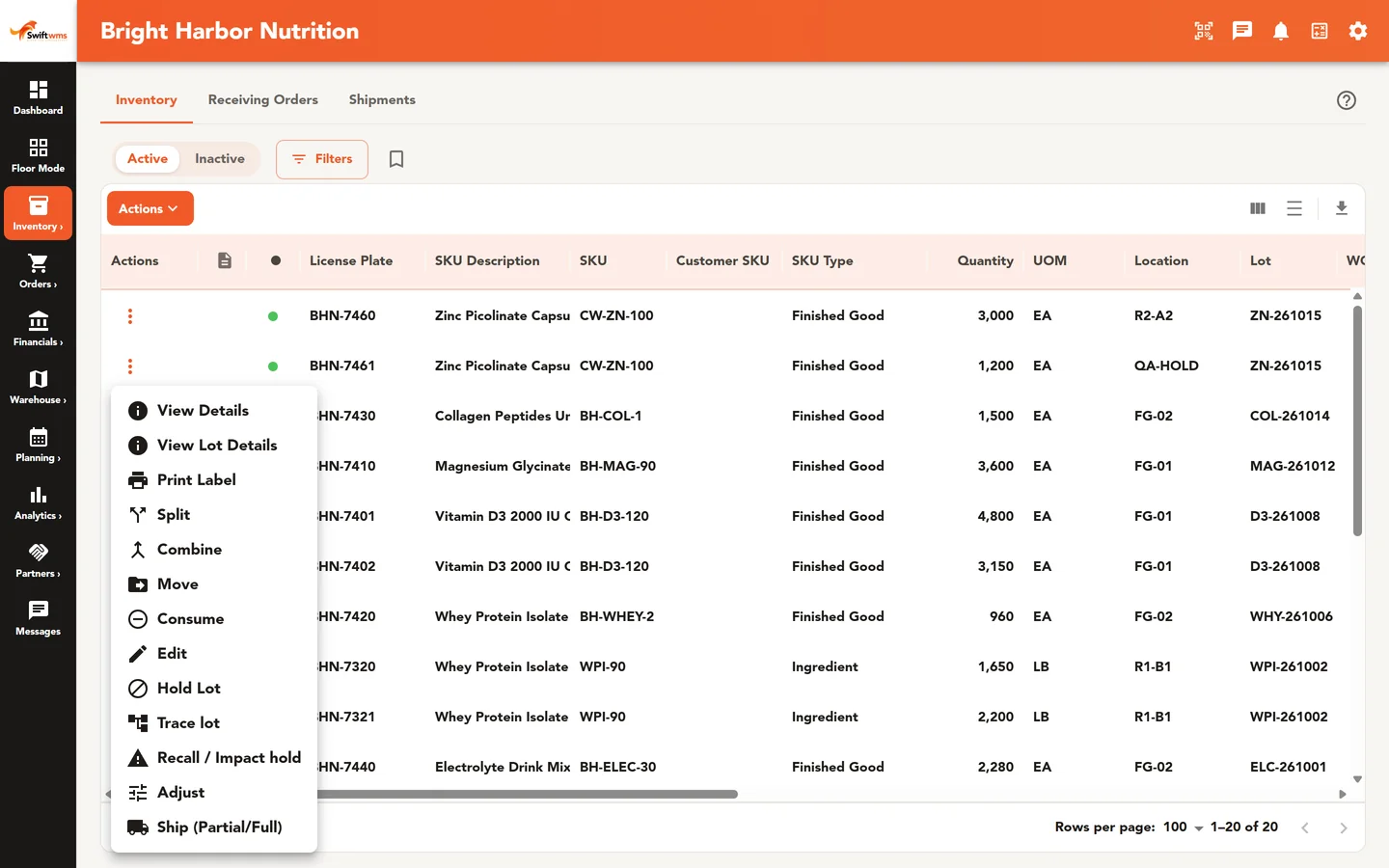
On lots, Fishbowl lists forward and backward lot traceability on its Scale tier, and lot and batch traceability on Advanced Manufacturing. In Swift WMS, lot traceability is part of the Core plan, the middle of three. Lot Trace follows a lot forward to every plate and shipment. Recall Impact starts from a bad lot, lists the downstream lots, work in progress, and shipped destinations, and can hold every impacted lot in one step. A held lot cannot ship. Read more on the lot traceability page.
Production and inventory in one plan
Fishbowl's pricing page says its Inventory plans do not include manufacturing, which it defines as BOMs, work orders, and MRP. For those, it points to Advanced Manufacturing, which lists full BOMs, sub-assemblies, work orders, and MRP with production scheduling.
Swift WMS keeps production in the same plan as receiving and lots. On Core, you get bills of materials, work orders, staging, batches, and a production schedule with capacity planning, next to receiving orders and Lot Trace. Staging reserves the exact plates a run needs, and batches consume those plates, so each finished lot records the lots that went into it. See production management for the full flow.
Built around the co-packer's customer
Many small plants make product for other brands. The stock on the racks belongs to those brands, and each one wants its own answers. In Swift WMS, every license plate is received under a customer, and it keeps that owner through holds, batches, and shipments.
The customer portal lets each customer log in and see its own inventory by SKU and lot, its orders, batch records, the COAs your team attached, and its invoices. It is included on Pro and is an add-on on Essentials and Core. Fishbowl lists a B2B Portal as an add-on, and its partner SalesIn describes a B2B portal that can show customers their current inventory levels. Our co-packers page shows how the portal works for a plant that makes product for many brands.
Fishbowl alternatives compared
If you are looking at Fishbowl alternatives, three other names come up often for small manufacturers. Each one suits a different kind of plant, and we set each one against Swift WMS on its own page, from that company's public pages.
- Katana: cloud manufacturing and inventory software for growing product businesses, built for brands that sell across many channels.
- MRPeasy: manufacturing software that it describes as ideal for companies with 10 to 200 employees, with prices published for every plan.
- BatchMaster: process manufacturing ERP for recipe- and formula-based manufacturers, with formula costing and accounting options.
- Swift WMS: warehouse and production software for small manufacturers and co-packers, built on license plates, lot traceability, and a customer portal.
Start from where the pain is. If it is formulas and costing, an ERP such as BatchMaster covers more. If it is selling across many channels, look at Katana. If it is knowing which lot sits on which pallet, where that pallet is, and which customer owns it, that is the gap Swift WMS was built to close.
When Fishbowl is the better fit
Fishbowl may be the right choice for some teams. These are the cases we would point to ourselves.
- You need your inventory tool to connect to your accounting software. Fishbowl lists accounting connections. Swift WMS does not offer one today.
- You want to run the software under your own control. Fishbowl says Advanced has self-managed options. Swift WMS runs as a browser app.
- You track serial numbers. Fishbowl lists serial number tracking. Swift WMS tracks lots and expiration dates.
- You want every price, add-ons included, before you talk to anyone. Fishbowl publishes prices for its Inventory tiers. Swift WMS publishes starting prices and quotes extra users and add-ons.
Common questions
- Does Fishbowl have lot tracking?
- Yes. Fishbowl's pricing page lists forward and backward lot traceability on its Scale tier, and lot and batch traceability on Advanced Manufacturing. Its food and beverage page also describes lot, serial, and expiration tracking, and support for recall plans. Check which tier you would need. In Swift WMS, Lot Trace, batch records, and Recall Impact are part of the Core plan.
- Does Swift WMS publish its prices?
- Yes, its starting prices. Swift WMS publishes starting prices: Essentials from $599, Core from $2,499, and Pro from $4,999 a month, with users included. Extra users, the customer portal on Essentials and Core, and yearly terms are quoted by our team. The customer portal is included on Pro. Fishbowl publishes prices for its Inventory tiers and confirms Advanced pricing by quote.
- Does Swift WMS connect to accounting software?
- No. Swift WMS does not sync with accounting software today. On the Core plan, WMS invoicing lets you bill customers for storage, receipts, and other fees, email invoices, and record payments made outside the app. Customers with portal access can pay online by card or bank. If an accounting connection is a must, weigh that before the other rows on this page.
- Can my customers see their own inventory in Swift WMS?
- Yes, with the customer portal. It is included on Pro and is an add-on on Essentials and Core. Each portal user sees only their own company's records: inventory by SKU and lot, orders, batch records, attached COAs, spec sheets, and invoices. You set access per user and per area, so a buyer and a quality contact can see different things.
- What are the main Fishbowl alternatives for small manufacturers?
- Katana, MRPeasy, and BatchMaster come up most often, next to Swift WMS. Katana suits product brands that sell across many channels. MRPeasy suits manufacturers of 10 to 200 people who want published per-user prices. BatchMaster suits formula-based plants that need costing and accounting in one system. Swift WMS suits plants and co-packers that need lot and pallet tracking by customer.
- Can we move from Fishbowl to Swift WMS?
- Yes. Swift WMS has a data import tool on every plan, and our team helps you import SKUs and starting stock. Onboarding is hands-on, not self-serve. A calm way to switch is to put new receipts on license plates first, then bring existing stock over one zone at a time. Talk to our team about what that could look like for your plant.
Sources
Checked on October 22, 2026.
- Fishbowl pricing page
- Fishbowl warehouse management page
- Fishbowl inventory page
- Fishbowl SalesIn integration page
- Fishbowl food and beverage page
Product names are trademarks of their owners. Spot an error? Tell us through our contact page and we will fix it.