Swift WMS and Katana side by side
| Topic | Swift WMS | Katana |
|---|---|---|
| Lot traceability | Lot and expiration on every plate. Lot Trace forward, batch records both ways, and Recall Impact with one-step lot holds. (Core and Pro) | End-to-end traceability via batch or serial numbers, listed on both plans. Expiration dates can be tracked on batches. Source |
| License plates | Every quantity sits on a license plate in a named location, with its own history. (All plans) | Bin locations, a warehouse app, and barcode scanning for receiving and stocktakes, listed on both plans. No license plate, LPN, or pallet ID wording. Source |
| BOM production | Bills of materials, work orders, staging, batches, and a line schedule with capacity planning. (Core and Pro) | Bills of materials with subassemblies, work order tracking, and a Shop Floor App for production teams. Source |
| Customer portal | Customers see their own inventory, orders, batch records, COAs, and invoices. (Included on Pro; an add-on on Essentials and Core) | No customer or B2B portal is listed in its plan tables. Source |
| Pricing transparency | Starting prices are published: Essentials from $599, Core from $2,499, and Pro from $4,999 a month, with users included. Extra users and add-ons are quoted. | A no-cost plan for up to 30 SKUs. The Advantage plan is custom pricing. Unlimited users on both plans. Source |
| Ideal customer | Small to mid-size manufacturers, co-packers, and food and CPG plants. | Growing product businesses selling across multiple channels and locations. No company size range stated. Source |
Lot traceability
- Swift WMS
- Lot and expiration on every plate. Lot Trace forward, batch records both ways, and Recall Impact with one-step lot holds. (Core and Pro)
- Katana
- End-to-end traceability via batch or serial numbers, listed on both plans. Expiration dates can be tracked on batches.
Source
License plates
- Swift WMS
- Every quantity sits on a license plate in a named location, with its own history. (All plans)
- Katana
- Bin locations, a warehouse app, and barcode scanning for receiving and stocktakes, listed on both plans. No license plate, LPN, or pallet ID wording.
Source
BOM production
- Swift WMS
- Bills of materials, work orders, staging, batches, and a line schedule with capacity planning. (Core and Pro)
- Katana
- Bills of materials with subassemblies, work order tracking, and a Shop Floor App for production teams.
Source
Customer portal
- Swift WMS
- Customers see their own inventory, orders, batch records, COAs, and invoices. (Included on Pro; an add-on on Essentials and Core)
- Katana
- No customer or B2B portal is listed in its plan tables.
Source
Pricing transparency
- Swift WMS
- Starting prices are published: Essentials from $599, Core from $2,499, and Pro from $4,999 a month, with users included. Extra users and add-ons are quoted.
- Katana
- A no-cost plan for up to 30 SKUs. The Advantage plan is custom pricing. Unlimited users on both plans.
Source
Ideal customer
- Swift WMS
- Small to mid-size manufacturers, co-packers, and food and CPG plants.
- Katana
- Growing product businesses selling across multiple channels and locations. No company size range stated.
Source
Where Swift WMS fits
Katana's pricing page lists end-to-end traceability for materials and products, by batch or serial number, on both of its plans. Its traceability page covers expiration dates on batches. Katana also lists bin-level locations and a Warehouse App with barcode scanning. Its pages do not use license plate, LPN, or pallet ID wording.
In a food or CPG plant, lots live on pallets. Swift WMS puts every quantity on a license plate in a named location, on every plan, and each plate holds one SKU and one lot. Ingredient SKUs need a lot name and an expiration date before a receipt can be saved, so the lot is never an optional column.
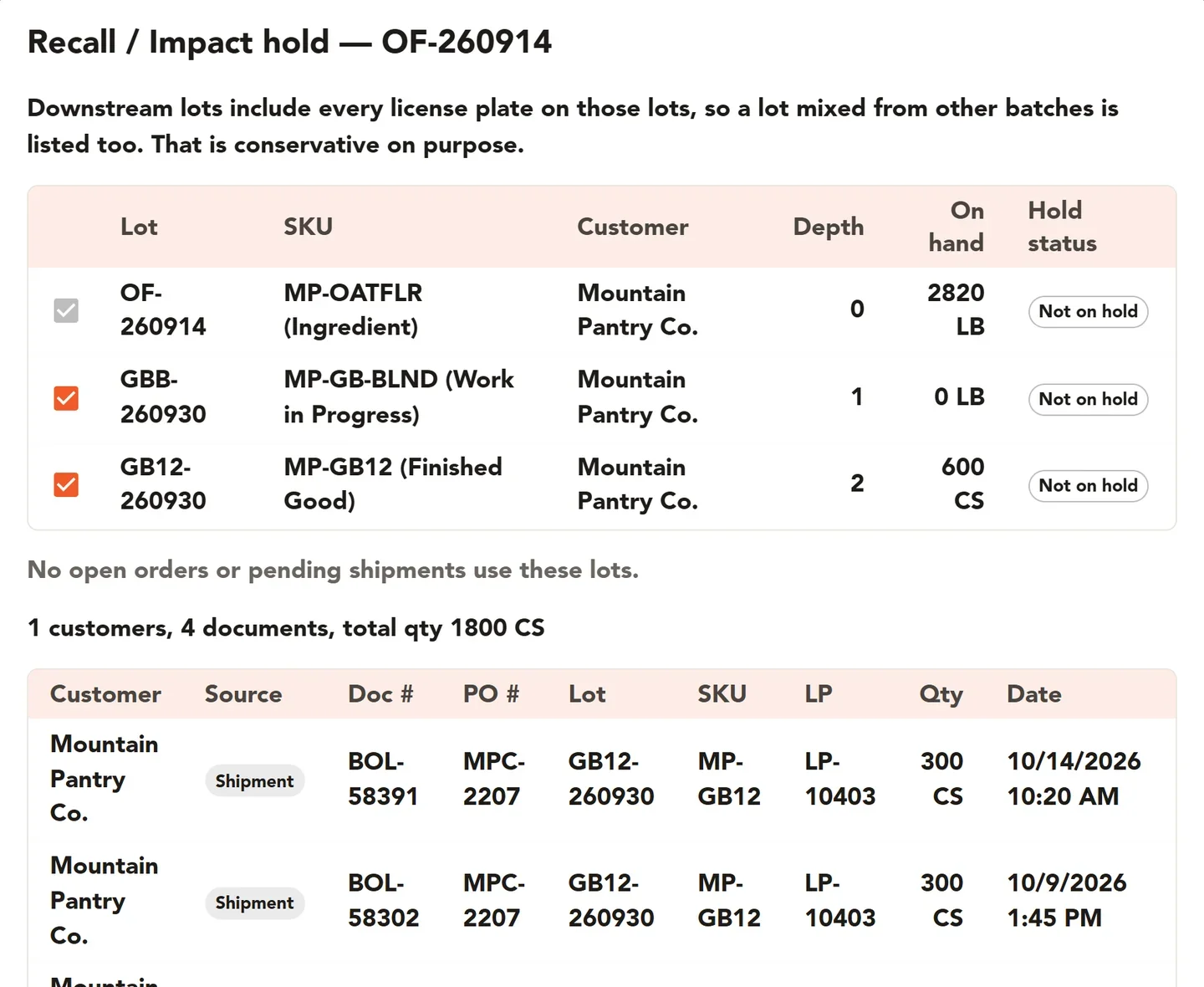
On the Core plan, Recall Impact starts from a bad lot and lists the downstream lots, the work still in progress, and the destinations where product shipped. You can hold every impacted lot in one step. A held lot cannot ship, and with lot holds turned on in production settings it cannot be consumed either. The lot traceability page covers Lot Trace and batch records too.
Making product for other brands
Katana has a page on managing outsourced production. It is written for the brand that sends work to contract manufacturers, and it describes giving each partner controlled access. Swift WMS is built for the other side of that deal: the plant doing the making.
Every license plate in Swift WMS is received under the customer who owns it, and it keeps that owner through holds, batches, and shipments. The customer portal gives each brand its own login to see its inventory by SKU and lot, its orders, batch records, and invoices. It is included on Pro and is an add-on on Essentials and Core. Portal users can also place a purchase order through a wizard. In Swift WMS, a purchase order is the customer's order to you, and your team approves or rejects it. See the customer portal page for details.
Quality records on the lot
Food and CPG customers ask for paperwork as often as they ask for stock counts. In Swift WMS, your team attaches COA files to the lot they cover, at receiving or later on the Quality page. Request COAs emails your suppliers to ask for them. Swift WMS stores the COAs you receive; it does not write them.
You can also choose to put new ingredient lots on hold when they arrive, so each one waits until quality reviews it and releases the hold. Finished product spec sheets can be shared with customers in the portal, where they can review and e-sign them. Quality features are part of the Core plan. Our page on food manufacturing shows how lots, holds, and COAs fit together in a food plant.
When Katana is the better fit
Katana may be the right choice for some teams. These are the cases we would point to ourselves.
- You sell across many channels and want your inventory tool tied to them. Katana says it is built for product businesses selling across multiple channels. Swift WMS does not offer online store integrations.
- You want a no-cost plan to start. Katana offers one for up to 30 SKUs. Swift WMS starts with a trial our team sets up.
- You want unlimited users on every plan. Katana lists unlimited users on both of its plans.
- You need accounting software sync. Katana lists accounting integrations. Swift WMS does not offer one today.
- You outsource production rather than run it. Katana's outsourced production page is written for that brand-side role.
Common questions
- Does Katana have batch tracking?
- Yes. Katana's pricing page lists end-to-end traceability for materials and products via batch or serial numbers on both of its plans, and its traceability page covers expiration dates on batches. In Swift WMS, every license plate carries its lot, and Lot Trace, batch records, and Recall Impact with one-step lot holds are part of the Core plan.
- Does Swift WMS have a customer portal?
- Yes. The customer portal is included on Pro and is an add-on on Essentials and Core. Each customer sees only its own records: inventory by SKU and lot, orders, batch records, the COAs your team attached, spec sheets, and invoices. You set access per user and per area. Customers can also place orders through a wizard, and your team approves each one.
- Does Swift WMS integrate with online stores?
- No. Swift WMS does not offer online store integrations. It is built for plants that make and store product, often for other brands. Customer orders come in as purchase orders, entered by your team or placed by customers in the portal. If most of your orders come from your own online stores, Katana may fit better.
- How is Swift WMS priced?
- Swift WMS publishes starting prices: Essentials from $599, Core from $2,499, and Pro from $4,999 a month, with users included. Extra users, the customer portal on Essentials and Core, and yearly terms are quoted by our team. Our team sets up a trial for you, and nothing is charged until the trial ends. Katana lists a no-cost plan for up to 30 SKUs and custom pricing for its Advantage plan.
- Is Swift WMS only for food?
- No. Swift WMS is for small to mid-size manufacturers and co-packers in general. Lot holds, expiration dates, and COAs matter most in food and CPG plants, but license plates, bills of materials, and work orders work for any plant that makes and stores product. Our team can tell you on a short call whether it fits the way your plant runs.
Sources
Checked on October 22, 2026.
- Katana pricing page
- Katana traceability page
- Katana product roadmap
- Katana warehouse management help article
- Katana batch manufacturing page
- Katana outsourced production page
- Katana home page
- Katana food inventory page
Product names are trademarks of their owners. Spot an error? Tell us through our contact page and we will fix it.