What FSMA 204 is
FSMA 204 is FDA's Food Traceability Rule. It comes from section 204 of the Food Safety Modernization Act. The goal is speed: when people get sick, FDA wants to find where a food came from and where it went in hours, not weeks.
The rule does not cover every food. It covers the foods on FDA's Food Traceability List, such as certain fresh produce, shell eggs, nut butters, and some seafood and cheeses. It also covers foods that contain a listed food as an ingredient, as long as that ingredient stays in the form the list names, for example still fresh. If none of your inputs or products are on the list, the rule's extra records do not apply to you.
FDA keeps the list, the full rule text, and guides for small businesses on its Food Traceability Rule page. Check that page first, because the details matter and they change.
The building blocks: events, data, and lot codes
The rule is built from three ideas. Once you know them, the rest of it is easier to read.
- Critical Tracking Events (CTEs) are the moments in a food's life that need a record: harvesting, cooling, initial packing, first land-based receiving of fish, shipping, receiving, and transformation. Most food plants deal with receiving, transformation, and shipping.
- Key Data Elements (KDEs) are the facts you record at each event. They change from event to event. For receiving, they include what came in, how much, from whom, and when.
- A traceability lot code is the lot code that follows the food. A plant assigns one when it initially packs a raw product, first receives fish from a boat, or transforms a food into something new. You do not make a new one just because you ship.
On top of the records, each covered business needs a written traceability plan. FDA must be able to get your records within 24 hours of asking. During an outbreak or recall, FDA can also ask for an electronic sortable spreadsheet of the records, again within 24 hours.
FDA has proposed a later compliance date for the rule, and Congress has told FDA not to enforce it before that date. Dates like this move, so check FDA's page for the current one instead of relying on any number printed elsewhere.
How Swift WMS supports FSMA 204 recordkeeping
Swift WMS tracks lots on the stock itself. On the Core and Pro plans, it also labels and checks those records in the terms the rule uses. Here is what it does.
- Food Traceability List flag. Mark a SKU as a list item and pick its FDA food category. You can filter the SKU list to list items, or set the flag on many SKUs at once.
- Event labels. Receiving, transformation, and shipping records carry the name of the Critical Tracking Event they cover, so you can see which record answers which part of the rule.
- Data element checks. For each event on a list lot, Swift shows which Key Data Elements are missing, and the FSMA 204 KDE Gaps report lists them in one place. The checks warn. They never block a save, so your team still fills the gaps.
- Lot code source. A lot can store a reference to where its traceability lot code was assigned, such as a facility registration number, a web address, or a short description.
- Ship-to address. A plate shipment can record the address it went to. Shipments made in bulk use the customer's default address.
- FDA sortable spreadsheet. Build an XLSX file with Receiving, Transformation, and Shipping tabs whose columns follow FDA's template. Rows with missing data elements are highlighted, and the file can include every downstream lot.
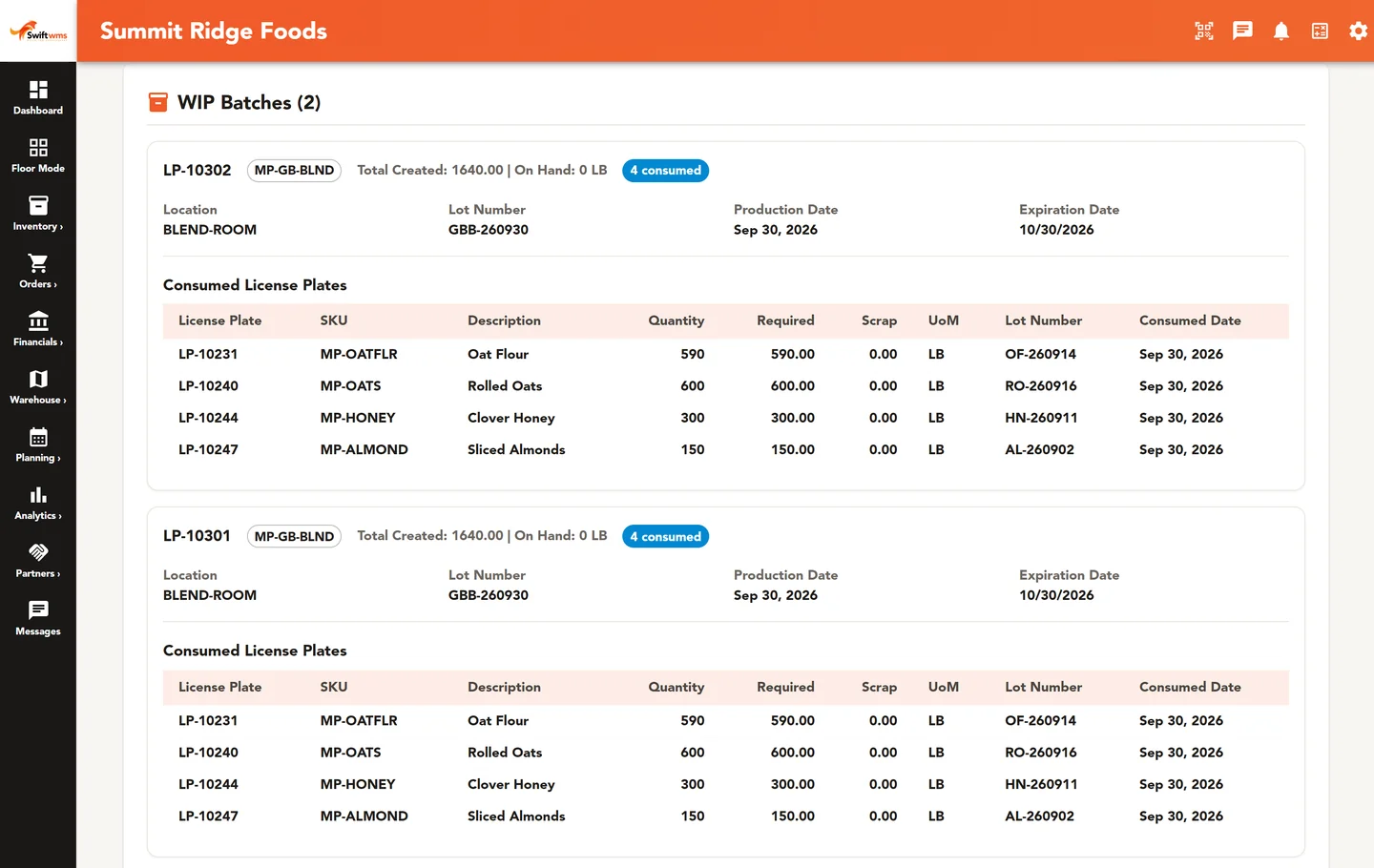
Under those labels are the records Swift has always kept. Received license plates hold the SKU, quantity, date, and user. Batch records list the input lots a batch consumed and the lot it made. Plate shipments hold the lot, quantity, date, and tracking ID. Our lot traceability page walks through Lot Trace, batch records, and Recall Impact.
Your traceability plan and the 24-hour drill
The rule asks for a written traceability plan. Swift gives it a home in Settings, on the Traceability Plan page. It has a section for each part the rule names: how you keep records, how you identify foods on the list, how you assign lot codes, and a point of contact. The page shows your live list of flagged SKUs, holds links to your own procedures, exports a PDF, and keeps every earlier version.
The Quality page also has a 24-hour drill. Pick a list lot and start the clock. Swift builds the FDA spreadsheet and the lot trace, you write down the gaps you found, and Finish saves a timestamped record of how long the trace took. The drill history and its log file show how your practice improves over time.
What Swift WMS does not do for FSMA 204
This is the part most vendors skip. If your plant handles foods on the list, you should know where the gaps are before you buy anything.
- No farm or first-receiver events. Harvesting, cooling, initial packing, and first land-based receiving of fish are not modeled, and the FDA spreadsheet has no tabs for them.
- No location identifiers. Swift does not store GLN or FEI numbers for your sites, suppliers, or customers.
- No guarantee that records are complete. Data element checks warn but never block, and brand, commodity, and variety are not checked.
- No consumer orders in the FDA spreadsheet. E-commerce orders to shoppers are left out of it.
- No plan written for you. Swift stores the plan and exports it, but the content is yours to write and keep current.
Swift WMS supports FSMA 204 recordkeeping. It does not make a plant meet this rule on its own, and it holds no certification. Your traceability plan, your records review, and your answers to FDA are still yours to own. Confirm your requirements with your quality team or regulator.
Practice before you need it
The 24-hour window is the part that hurts in a real event. The best way to find your gaps is to run a trace when nothing is wrong. Pick a lot, trace it forward and back, and time how long it takes to account for every unit. Our guide on how to run a mock recall walks through it step by step.
For the wider picture of how lot records support a food plant, see our page for food manufacturers. To see these records with your own lots, contact our team.
Common questions
- Does Swift WMS make us meet FSMA 204?
- No software can do that on its own. Swift WMS supports FSMA 204 recordkeeping on the Core and Pro plans. It flags Food Traceability List items, labels receiving, transformation, and shipping events, warns about missing data elements, and gives your traceability plan a home. Your team still owns the plan, reviews the records, and answers FDA. Confirm your requirements with your quality team or regulator.
- Can Swift WMS produce the FDA sortable spreadsheet?
- Yes, for lots of Food Traceability List items on the Core and Pro plans. The FDA spreadsheet button on the Quality page, in Lot Trace, and in Recall Impact builds an XLSX file with Receiving, Transformation, and Shipping tabs that follow FDA's column template, plus a summary tab. Rows with missing data elements are highlighted. You can also download each tab as a CSV file. Harvesting and cooling events are not included.
- Does the rule apply to my products?
- It depends on the Food Traceability List. The rule covers foods on the list and foods that contain a listed food in the form the list names. FDA publishes the list and tools for checking your products on its Food Traceability Rule page. If nothing you handle is on the list, the extra records in this rule do not apply to you.
- Can we use Swift WMS lot names as traceability lot codes?
- Yes. Record your traceability lot code as the lot name, and the lot then follows each license plate through receiving, production, and shipping. Each lot can also store a reference to where its code was assigned. Swift WMS does not store GLN or FEI location identifiers, so keep those elsewhere if your plan needs them.
- Can we run a mock recall in Swift WMS?
- Yes. On the Core plan, start Recall Impact from a lot to see downstream lots, work in progress, and shipped rows, and export the results. The 24-hour drill on the Quality page times a trace of a list lot and saves the result. Be careful with the bulk hold during practice: holding real lots blocks shipping until someone releases them.